


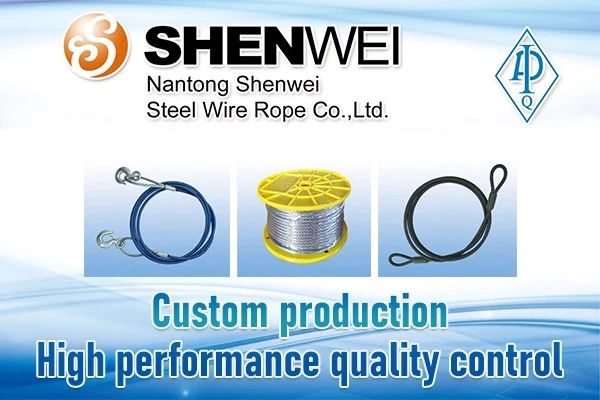
Shenwei as a professional wire rope manufacturer, we provide comprehensive OEM customization services. We precisely customize wire ropes in various materials (e.g., galvanized, stainless steel, plastic-coated) and special structures (e.g., multi-strand, compacted) to meet the needs of different applications such as lifting, port operations, mining, and elevators. We specialize in producing steel wire rope with features like high-temperature resistance, rotation resistance, and low elongation, strictly controlling strength, flexibility, and anti-corrosion grades to ensure safety and reliability in demanding environments. With advanced equipment and a rigorous quality control system, we are committed to being your trusted long-term partner.
Design factors for custom steel wire ropes
Structure & Construction
The internal design of the wire rope is crucial for its performance. Key choices include the number of strands, wires per strand, and the lay type (regular lay vs. lang lay). Common constructions like 6x19 or 6x36 offer a balance of flexibility and abrasion resistance. Special designs like compacted strands or rotation-resistant ropes are available for specific needs like heavy lifting or multi-fall systems, directly affecting fatigue life, flexibility, and strength.
Purpose
Clearly define where and how the rope will be used (e.g., mining draglines, crane hoisting, elevator systems, marine mooring). This determines the required performance. Consider environmental factors like exposure to water (requiring corrosion resistance), high temperatures, abrasive surfaces, or heavy shock loads. The application dictates the necessary safety factors, endurance, and suitability for dynamic or static loads.
Technical Specifications & Material
This covers the core type (fiber core for flexibility or independent wire rope core for strength and crush resistance), wire grade (improved plow steel, stainless steel, etc.), and protective coatings. Choices include galvanizing for corrosion protection or specialized polymer coatings. The required minimum breaking strength, nominal diameter, and compliance with international standards (e.g., API, DIN, EN) are fundamental technical parameters that must be specified.
Length & Ends
Specify the exact cut length and tolerance. Also, decide on the end terminations or fittings needed for immediate installation. Common terminations include swaged sockets, pressed eyes, loops with thimbles, or threaded studs. The type of termination affects the assembly's ultimate strength and connection method to your equipment. Providing details ensures the rope arrives ready for use.
Packaging & Delivery
Indicate the preferred packaging method for protection during transport and storage. Options include wooden reels, steel reels, or coiled and bound with straps. For long lengths, specify if multiple reels are acceptable. Special packaging like waterproof wrapping or reel dimensions for specific handling equipment can also be requested to prevent damage and facilitate on-site handling.
Labeling
Clear marking is essential for traceability and safety. Specify required information on the reel tag or rope label, such as manufacturer's name, standard/grade, diameter, length, construction, lot number, and manufacturing date. Custom markings like your company's part number, project name, or safety warnings can be included. Proper labeling ensures correct identification throughout the supply chain and on-site.
Our process turns strong steel wire into strong wire rope.
1. Drawing Wire: We start by pulling steel rods through special moulds. This makes them longer, thinner and much stronger.
2. Stranding: A precise number of these strong wires are twisted together to form a single strand. This step is important to see how flexible and strong the rope is.
3. The rope is closed by twisting multiple strands together in the opposite direction around a central core. This core can be made of fiber (to make it flexible) or another steel strand (to make it strong). We twist them to make the final rope structure.
4. Finishing: Once the rope is formed, it goes through some important finishing steps. We apply a special lubricant inside and out to many ropes to reduce friction and prevent rust.
5. Testing: Finally, the rope is cut to the exact length you need. We can also add end fittings (like loops or sockets) if needed. Before shipping, we test critical samples to make sure they meet all the necessary strength and safety standards.