Meta Description
Compare 6×19 and 8×19 steel wire rope in flexibility, abrasion resistance, fatigue performance and applications. Learn how to choose the right wire rope construction.
What Is 6×19 Steel Wire Rope?
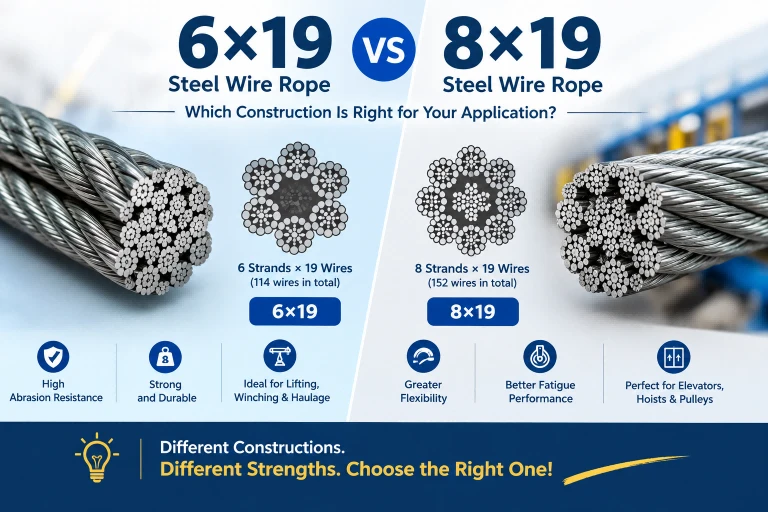
A 6×19 steel wire rope consists of six strands, with approximately 19 wires in each strand. It is a popular general-purpose construction known for its good balance of strength, abrasion resistance and flexibility.
Compared with more flexible constructions, 6×19 is relatively stiff, but its larger outer wires provide good resistance to wear and abrasion. It is commonly used for:
General lifting
Cranes and hoists
Winches
Dragging and haulage
Mining equipment
Wire rope slings
6×19 is particularly suitable when the rope is exposed to abrasion or relatively heavy surface contact.

What Is 8×19 Steel Wire Rope?
An 8×19 steel wire rope has eight strands with approximately 19 wires per strand. Compared with 6×19, the additional strands create a rope with a rounder profile and generally greater flexibility.
8×19 is commonly selected for applications where the rope needs to pass repeatedly over sheaves and pulleys. It is also widely associated with elevator and hoisting applications.
Typical applications include:
Elevator wire rope
Hoisting equipment
Cranes
Winches
Pulley systems
Applications requiring frequent bending

6×19 vs. 8×19: Key Differences
| Feature | 6×19 Steel Wire Rope | 8×19 Steel Wire Rope |
|---|---|---|
| Number of Strands | 6 | 8 |
| Wires per Strand | Approx. 19 | Approx. 19 |
| Flexibility | Moderate | Higher |
| Abrasion Resistance | Very good | Good |
| Bending Fatigue | Good | Generally better |
| Typical Use | Lifting, winching, haulage | Elevators, hoists, pulleys |
| Best Feature | Wear resistance | Flexibility |
In general, 6×19 is a good choice when abrasion resistance is a priority, while 8×19 is more suitable when flexibility and repeated bending are important.
Which One Should You Choose?
Choose 6×19 When:
The rope experiences significant abrasion.
The application involves lifting, pulling or dragging.
The rope does not need to bend continuously.
Durability against external wear is a major concern.
For example, 6×19 IWRC steel wire rope is commonly used in general lifting and industrial applications where strength, abrasion resistance and crush resistance are important.
Choose 8×19 When:
The rope passes frequently over sheaves or pulleys.
Flexibility is more important than maximum abrasion resistance.
The application involves repeated bending.
You are selecting rope for elevator or hoisting equipment.
For elevator applications, specific constructions such as 8×19S, 8×19W or 8×19 IWRC may be selected depending on the equipment and applicable requirements.
What About the Core?
The core is another important factor when comparing wire ropes.
FC (Fiber Core) provides greater flexibility and can be suitable for applications where flexibility is important.
IWRC (Independent Wire Rope Core) provides greater metallic support, crush resistance and strength, making it widely used in industrial lifting and heavy-duty applications.
Therefore, buyers should not select a rope based only on 6×19 or 8×19. The core type, diameter, tensile strength, lay and working conditions should also be considered.

6×19 vs. 8×19: Quick Selection Guide
Heavy abrasion → 6×19
General lifting and winching → 6×19
Frequent bending → 8×19
Sheaves and pulleys → 8×19
Elevator applications → 8×19
The correct choice should always be based on the actual equipment, working load, sheave/drum dimensions and applicable standards.
Conclusion
Both 6×19 and 8×19 steel wire rope are widely used constructions, but they are designed to meet different performance requirements.
6×19 is a practical choice for general lifting, winching and applications where abrasion resistance is important. 8×19 offers greater flexibility and is better suited to applications involving frequent bending, pulleys, hoists and elevators.
If you are unsure which construction to choose, consider the working load, bending frequency, sheave diameter, core type, operating environment and required service life before making a final decision.

Related Products