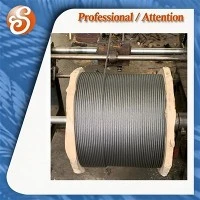
Let's talk about the real workhorse on any job site-the crane wire rope. You see the crane move, but the cable doing the lifting? That's the quiet star. It's not just a piece of metal; it's the critical link that holds everything together, literally.
Every day, these ropes lift loads that can weigh as much as several elephants. They bend over sheaves, face dust, rain, and constant strain. The real story is how they're built for this. Manufacturers spin together high-grade steel wires into strands, and those strands into a rope. The best ones use a special grade of steel, often called "crane-grade," made for toughness and flexibility. A key thing is the "coating." A high-quality zinc coating, applied through a hot-dip process, is what fights off rust. This simple layer can extend a rope's life on a coastal site by years, saving thousands of dollars in early replacements.
The big change lately isn't just in the steel, but in the smarts. Some of the newest ropes coming from advanced mills have technology woven right in. Think of tiny sensors or special marker materials inside the core. This lets the rope give warnings. It can signal when it's been under a load that was too heavy or when the internal friction is getting high. For a site manager, this isn't just a cable; it's a report on safety, helping plan maintenance before a problem happens.
Back in the warehouse, my customers tell me their needs have changed. It's not just about the lowest price per foot anymore. A contractor for a wind farm project will ask for a rope with extreme fatigue resistance for hoisting turbines. A port maintenance crew needs a rope that can handle the non-stop, heavy cycles of loading ships. They know that a reliable rope from a trusted manufacturer means less downtime. A failure doesn't just cost the price of a new rope; it stops a $20.000-per-day project in its tracks.
Choosing the right one comes down to a few simple, solid facts. You match the rope's "minimum breaking force," clearly rated in tons, to your crane's job-with a big safety margin. You look at its construction, like a 6x36 or 8-strand pattern, which balances flexibility and wear life. You check its core, which can be a simple fiber or a strong independent wire rope core (IWRC) for heavier duties. And you always, always follow the crane manufacturer's spec sheet. It's the blueprint for safety.
In the end, the coil of wire rope on your shelf is more than inventory. It's a product of serious engineering made for one purpose: to perform under pressure so your project can too. It's the unsung hero you trust every time you give the signal to lift.