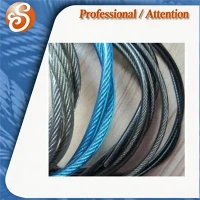
If you’ve ever worked with steel wire ropes for industrial, commercial, or even residential projects, you know how critical protective coatings are—these thin layers aren’t just for making a rope look neat, they’re the first line of defense against corrosion, abrasion, and environmental damage. As a coated steel wire rope supplier, I get asked this question all the time: Is the coating on steel wire rope resistant to chemical solvents? The short answer is that it depends entirely on the type of coating, the specific solvent in question, and how the rope is designed to be used. But let’s dive into the science behind this, break down common coating types, and share real-world lessons I’ve learned from working with clients across industries.
First, let’s get one thing straight: Not all coatings are created equal. The two most common coatings you’ll find on steel wire rope are PVC (polyvinyl chloride) and nylon, each with very different chemical resistance profiles. I’ve seen clients reach for the wrong coating for a job, and it always leads to avoidable headaches—like a warehouse rope failing because the PVC dissolved when it came into contact with cleaning chemicals, or a gym cable fraying because the nylon coating couldn’t stand up to repeated exposure to sweat and cleaning solutions. Let’s start with the most widely used coating, PVC, because it’s the workhorse of our product line.
PVC is a thermoplastic polymer known for its versatility, affordability, and excellent resistance to many common chemicals—wait, but it’s not invincible. Over the years, I’ve recommended our PVC coated galvanized wire rope for everything from marine applications to construction sites, and here’s what I tell clients about its solvent resistance. PVC performs very well against mild, polar solvents like water, dilute acids, and dilute alkalis. For example, if you’re using a rope to lift construction materials that come into contact with concrete washings, or a marine rope exposed to saltwater (which is a mild saline solution), PVC holds up great. But when it comes to strong solvents—like ketones (acetone, methyl ethyl ketone), esters, chlorinated hydrocarbons (like trichloroethylene used in some industrial degreasers), or concentrated acids or bases—PVC starts to break down. It can swell, soften, or even dissolve when exposed to these chemicals over time, especially with repeated contact or prolonged exposure.
I recently had a client in the automotive industry call us panicking because their old lifting ropes were failing after just a few months of use in a workshop where they use heavy-duty degreasers. They had bought generic uncoated ropes that they tried to “protect” with a DIY PVC spray, and it wore away completely in weeks. We directed them to our durable 7X19 PVC coated galvanized steel wire rope for plants and industrial applications, which is specifically formulated with a thicker, cross-linked PVC layer that has improved resistance to mild industrial solvents. Even so, I had a follow-up conversation with their team last month, and we agreed that for the parts of their process where they use concentrated degreasers, we’d recommend a different coating entirely. That’s a perfect example of why understanding solvent compatibility matters so much—choosing the right coating isn’t just about price, it’s about matching the product to its operating environment.
Let’s talk about another common product from our line: PVC coated steel wire rope with higher tensile strength, like our 1770N/mm2 19x7 R.H.R.L. option. This rope is used for heavy-duty lifting in harsh industrial environments, and we test its chemical resistance rigorously before it leaves our facility. We subject samples to 100 hours of exposure to common solvents and measure how much the coating’s thickness changes, how well it adheres to the underlying galvanized steel, and how much of the rope’s tensile strength is retained. What we’ve found is that this high-strength PVC coating is still susceptible to the same strong solvents as standard PVC, but its thicker composition means it takes longer to break down—making it a better choice for environments where solvent exposure is moderate, not extreme.
Now, what about when the environment has harsher solvents? That’s where nylon coatings come in. Our 7X7 nylon coated steel wire cable for flexible gym equipment is a great example of a nylon coating, and it has very different chemical resistance than PVC. Nylon (polyamide) is more resistant to strong solvents like alcohols, many weak acids, and even some dilute alkalis, but it’s actually less resistant to concentrated acids than PVC. Wait, that’s counterintuitive, right? It’s why matching the coating to the specific solvent is non-negotiable. For gym equipment, the nylon coating holds up well to sweat (which is mild saline) and common gym cleaning solutions, but we’d never recommend it for a workshop where there’s exposure to strong degreasers. I once had a fitness equipment manufacturer ask for a nylon coated rope for use in a commercial pool, and we had to explain that pool chemicals like chlorine are a strong oxidizer that would break down nylon over time—we instead recommended a specially formulated PVC coated rope that’s designed for chemical-resistant outdoor applications.
I want to clarify a common misconception here: The underlying steel of the rope also plays a role, but the coating is the primary barrier to chemical solvents. For example, our PVC coated galvanized wire rope has a layer of zinc on the steel core that provides extra corrosion resistance, but the PVC coating is what blocks solvents from reaching the steel. If the coating is damaged—from abrasion, heavy impact, or poor installation—the solvent can get through to the zinc and then the steel, leading to corrosion even if the coating is chemically resistant. That’s why proper installation and regular inspection are just as important as choosing the right coating. A client recently had a rope that looked perfect on the surface but had a small, hidden cut in the PVC coating; when they used it in a facility with mild acid fumes, the fumes got through the cut and corroded the steel core, leading to unexpected failure. We now include a care guide with every one of our coated steel wire ropes that emphasizes inspecting for coating damage regularly, especially in high-exposure environments.
So, let’s summarize the key points about coating resistance to chemical solvents, based on years of working with these products:
First, always identify the specific solvents your rope will be exposed to. Is it mild solvents like water, saltwater, dilute cleaning solutions, or is it strong solvents like ketones, concentrated acids, or chlorinated degreasers? That determines which coating is right for you.


Second, PVC coatings are excellent for most general industrial, marine, and construction applications where solvent exposure is moderate. Our range of PVC coated products—from the good quality 6X19+FC PVC coated flexible steel wire rope for warehouse use to the heavy-duty 1770N/mm2 lifting ropes—are all formulated to handle mild solvents effectively. They are not, however, resistant to strong solvents, so if your process uses those, you’ll need to look at specialized coatings (though nylon is a better fit for some solvent types, as we discussed).
Third, nylon coatings offer better resistance to certain solvents like alcohols and mild chemicals, making them ideal for gym equipment, light machinery, and even some medical applications, but they fall short against strong acids and high-temperature solvent exposure.
Fourth, even the most chemically resistant coating is only as good as its installation and maintenance. Damage to the coating from abrasion, bending, or impact creates weak points where solvents can penetrate, leading to premature failure. I always advise clients to choose a rope with a coating thickness matched to their use case—thicker coatings for higher-abrasion, higher-exposure environments, and thinner coatings for applications where flexibility is more important (like our flexible gym cables).
As someone who works directly with clients every day to solve their rope and cable challenges, I can’t stress enough that there’s no one-size-fits-all answer to whether coated steel wire rope is resistant to chemical solvents. The best approach is to partner with a supplier who understands the nuances of different coatings and their applications. I’ve seen too many projects go over budget or fail prematurely because someone picked a rope based on price alone, without considering the specific chemical environment it would be in.
If you’re working on a project where solvent exposure is a concern, whether it’s in manufacturing, marine operations, construction, fitness, or any other industry, I’m here to help you find the right coated steel wire rope for your needs. Our team has years of experience testing and supplying these products, and we can walk you through the pros and cons of each coating to make sure you get a rope that’s durable, reliable, and tailored to your exact operating conditions. Don’t hesitate to reach out to our team to discuss your requirements and find the perfect solution for your project.
References
- “Chemical Resistance of Thermoplastic Coatings for Metal Wires.” NACE International, 2021.
- PVC Coated Wire Rope: Performance Characteristics and Application Guidelines. Wire Rope Industry Association, 2020.
- “Nylon vs. PVC Coatings: Comparative Chemical Resistance for Industrial Cables.” Journal of Industrial Textiles, vol. 48, no. 3, 2018, pp. 452-470.
- Galvanized Steel Wire Rope Corrosion: The Role of Coating Integrity. Corrosion Science, vol. 152, 2019, pp. 108245.