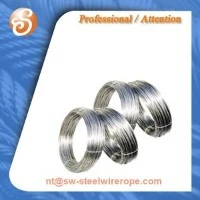
If you’ve ever shopped for spring components, chances are you’ve come across stainless spring steel wire, and as someone who’s supplied this material for more than a decade, I get asked this question all the time: what makes it different from regular steel wire, and why do so many industries rely on it for critical applications?
Stainless spring steel wire isn’t just another type of wire—it’s a specialized alloy engineered to balance strength, corrosion resistance, formability, and long-term durability. Unlike plain carbon steel wire, which rusts easily and loses elasticity over time, this material is crafted to meet the exact demands of springs that operate in harsh environments, from automotive engine bays to medical device sterilization cycles. Let’s break down the core characteristics that set it apart, and why partnering with a reliable supplier matters more than you might think.
First, the alloy composition is non-negotiable. Stainless spring steel wire isn’t a single alloy—it’s a group of alloys, most commonly 302, 304, and 316 austenitic stainless steels, with small additions of carbon, manganese, and other elements tailored to boost spring properties. For context, austenitic grades make up roughly 70% of all stainless steel used in springs because they offer a rare mix of formability (you can bend, coil, or shape them without cracking) and high tensile strength. Carbon is added in controlled amounts—usually 0.08% to 0.15%—to increase the wire’s ability to resist stretching under load, a key trait for springs that need to maintain their shape over millions of cycles. Grades like 316 even add molybdenum, which gives them extra resistance to chloride corrosion, making them ideal for marine applications or food processing equipment where salt or cleaning chemicals are present.
That brings us to corrosion resistance, the biggest advantage over regular steel. Plain carbon steel forms rust when exposed to moisture, oxygen, or even mild chemicals, which weakens the material and can cause springs to fail prematurely. Stainless spring steel, on the other hand, forms a self-healing chromium oxide layer on its surface when it comes into contact with oxygen. This thin, invisible layer acts as a barrier, preventing moisture and contaminants from reaching the iron beneath. The thickness of this layer depends on the grade: 304 has about 18% chromium, enough to resist rust in most indoor or low-exposure settings, while 316’s molybdenum addition lets it withstand saltwater, acidic cleaners, and even mild industrial chemicals. I see customers make the mistake of buying ungalvanized spring steel wire (often marketed as a cheaper alternative) for outdoor or wet applications, only to have their springs corrode within a year. That’s why it’s critical to match the grade to your operating environment, and as a supplier, we always help customers navigate that choice.
Next, elastic limit and fatigue resistance—these are the superpowers that make springs work. A spring’s job is to absorb and release energy repeatedly, so if it deforms permanently after a few cycles, it’s useless. Stainless spring steel wire has a high elastic limit, meaning it can stretch, compress, or twist without taking a set (permanent deformation). That’s tested in our facility through tensile testing, where we measure how much force the wire can handle before it doesn’t bounce back. Even more important is fatigue resistance: springs operating in applications like automotive valve springs, electric motor brushes, or consumer electronics hinges can cycle millions of times a year. Stainless spring steel’s ability to resist crack growth under repeated stress means these springs won’t break or lose tension over their lifecycle. For example, a 316 stainless spring used in a marine boat’s throttle mechanism will flex thousands of times a season, resist saltwater corrosion, and last for decades—something regular carbon steel wire could never do.
Formability is another key characteristic, especially for custom spring designs. Unlike some high-strength alloys that are hard to shape, stainless spring steel wire can be cold-drawn or heat-treated to get the right balance of strength and flexibility. Cold drawing involves pulling the wire through a series of dies to reduce its diameter, which aligns the metal’s grain structure and increases strength without adding heat. This method gives the wire consistent properties along its entire length, which is critical for springs that need uniform tension. For customers who need custom sizes—from tiny 0.1mm wire for watch springs to 10mm wire for heavy-duty industrial springs—formability ensures we can meet their exact specifications without sacrificing performance. That said, there’s a limit: too much cold drawing without annealing can make the wire too brittle, so our team carefully controls the process to avoid that issue.
Temperature resistance is often overlooked, but it’s make-or-break for many applications. Stainless spring steel can operate in a wide temperature range: 304 grade works well from -200°C (used in cryogenic equipment like medical refrigerators) up to 800°C, while 316 can handle up to 850°C. This is a huge benefit over carbon steel, which loses its strength rapidly above 200°C and can become brittle at low temperatures. For example, automotive exhaust system springs operate at 500-700°C, and medical implant springs (like pacemaker leads) experience body temperature (37°C) and sterilization cycles at 121°C—all areas where stainless spring steel maintains its properties. If a spring fails in an exhaust system, it can lead to expensive repairs; in a pacemaker, it’s a life-safety issue, so temperature stability is non-negotiable.
Now, let’s talk about why choosing a reliable supplier matters for these characteristics. Not all stainless spring steel wire is created equal. Some cheap sources use lower-grade stainless steel, cut corners in the alloy composition, or skip critical testing steps, leading to wire that rusts easily, has inconsistent strength, or breaks after a few cycles. As a supplier, we specialize in high-quality stainless spring steel wire, with rigorous quality checks at every stage of production: alloy composition verification, tensile strength testing, surface finish inspection, and fatigue testing. We also offer technical support to help customers select the right grade for their application—whether they need 304 for general industrial use or 316 for marine or medical environments. If you’re looking for a trusted option, we also provide ungalvanized spring steel wire for applications where coating is not desired, but we always advise on the best choice based on your project’s needs.
We understand that when you’re sourcing spring wire, you need more than just a product—you need a partner who can deliver consistent, reliable material on time and help you solve problems if they arise. Whether you’re a small business making consumer hinges or a large manufacturer building automotive components, we work with clients of all sizes to meet their requirements.
If you have questions about which stainless spring steel wire is right for your project, need a custom size, or want to discuss pricing and lead times, don’t hesitate to get in touch to arrange a procurement conversation.
References

- ASM International. (2020). Stainless Steels for Spring Applications. Materials Park, OH: ASM International.
- Davis, J. R. (Ed.). (1998). Specialty Stainless Steels. ASM International.
- Engineering Toolbox. (2022). Spring Steel Wire Properties. Retrieved from engineeringtoolbox.com.
- International Organization for Standardization. (2019). ISO 683-17: Heat-Treatable Steels, Stainless Steels, and Free-Machining Steels. ISO.
- Noyes, G. (2021). Corrosion Resistance of Stainless Steels for Industrial Applications. Corrosion Science, 189, 109652.