When selecting a steel wire rope, buyers often focus on rope construction, diameter, tensile strength and surface finish. However, core type is another important factor that can significantly affect rope performance.
The two common options are Fiber Core (FC) and Independent Wire Rope Core (IWRC). Both are widely used in industrial applications, but they offer different advantages in terms of flexibility, strength, crush resistance and operating conditions.
Understanding the difference between fiber core and steel core wire rope can help buyers select the right rope for their equipment and working environment.


What Is a Fiber Core Wire Rope?
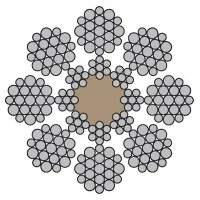
A fiber core wire rope uses a core made from natural or synthetic fibers. According to EN 12385-2, fiber cores can be made from natural fibers or synthetic fibers.
The main function of the core is to support the outer strands and help maintain the rope's shape. Fiber cores are also known for providing good flexibility.
A fiber core can also retain lubricant within the rope, helping reduce internal friction during operation.
Main advantages of fiber core:
Good flexibility
Easier handling
Good bending performance
Can retain lubricant
Suitable for applications where flexibility is important
Because of these characteristics, FC wire rope can be considered for applications involving frequent bending and relatively moderate loading conditions.
What Is a Steel Core Wire Rope?
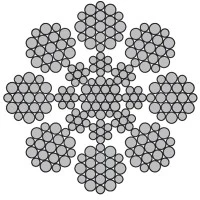
A steel core wire rope uses a steel-based core to support the outer strands. One of the most common steel-core configurations is IWRC (Independent Wire Rope Core), where a separate small wire rope forms the core of the main rope.
EN 12385-2 defines steel cores as wire strands or independent wire ropes.
Compared with a fiber core, an IWRC provides stronger radial support to the outer strands. It also offers better resistance to crushing and generally provides higher breaking force for the same nominal rope diameter.
Main advantages of steel core:
Higher breaking force
Better crush resistance
Greater radial stability
Better support during multi-layer winding
Better resistance to elevated temperatures than fiber-core ropes
This makes IWRC steel wire rope particularly useful for cranes, hoists, winches and other demanding lifting applications.
Fiber Core vs. Steel Core: Key Differences
| Feature | Fiber Core (FC) | Steel Core (IWRC) |
|---|---|---|
| Flexibility | Higher | Lower |
| Breaking force | Lower | Higher |
| Crush resistance | Moderate | High |
| Radial stability | Lower | Higher |
| Lubricant retention | Good | Different lubrication behavior |
| Heat resistance | Lower | Higher |
| Multi-layer winding | Less suitable for high crushing loads | Better suited |
| Typical applications | Flexible running ropes, general applications | Cranes, hoists, heavy lifting, winches |
The actual performance also depends on rope construction, diameter, steel grade, lay, lubrication and operating conditions. Therefore, core type should not be evaluated independently.


Why Does Steel Core Provide Higher Strength?
The steel core itself contributes to the metallic cross-sectional area of the rope.
For a comparable rope diameter, replacing a fiber core with an IWRC can increase the rope's breaking force. The exact difference depends on the rope construction and diameter rather than being a single fixed percentage. For example, published data show that the increase can vary between constructions.
The steel core also provides a firm internal foundation for the outer strands. This is particularly important when the rope is subjected to high radial pressure, such as when it is wound onto a drum in multiple layers.
Which Core Is Better for Cranes and Heavy Lifting?
For demanding lifting applications, steel core wire rope is commonly selected because of its higher radial stability, crush resistance and breaking force. NSW Government guidance specifically notes that wire rope core provides additional strength and support in multi-layered applications to help prevent crushing.
For example, applications such as:
Overhead cranes
Tower cranes
Construction hoists
Mining equipment
Winches
Heavy lifting equipment
Multi-layer drum systems
may require an IWRC construction depending on the equipment manufacturer's specifications.
However, the correct rope should always be selected according to the equipment, working load, sheave/drum diameter, rope construction and applicable safety requirements.
When Should You Choose Fiber Core?
A wire rope with fiber core can be considered when flexibility and easy handling are important.
Typical considerations include:
Frequent bending around sheaves
Single-layer winding
Applications where high flexibility is required
Moderate loading conditions
Situations where rope handling is important
Fiber-core ropes can also be advantageous because the core can help retain lubricant. However, fiber cores have lower resistance to crushing and high temperatures than steel cores.

When Should You Choose Steel Core?
A wire rope with steel core is generally more suitable when the rope needs greater support and resistance to deformation.
Consider IWRC when the application involves:
Heavy loads → Multi-layer winding → High radial pressure → Crushing risk → Higher temperature → High breaking-force requirements
For example, crane and hoisting ropes often use IWRC because the steel core helps maintain rope geometry under demanding operating conditions.

How to Choose the Right Core?
Instead of simply asking whether FC or IWRC is better, buyers should consider the actual working conditions.
Ask these questions before selecting the rope:
1.What is the maximum working load?
2.Does the rope run over sheaves frequently?
3.Is the rope wound onto the drum in multiple layers?
4.Is crushing or flattening a concern?
5.What is the operating temperature?
6.Is flexibility more important than maximum strength?
7.What rope construction and diameter does the equipment manufacturer specify?
The answer to these questions will help determine whether a fiber core or steel core is more appropriate.
Conclusion
The main difference between fiber core and steel core wire rope is the balance between flexibility and structural support.
Fiber Core (FC) provides good flexibility and lubricant retention, making it suitable for applications where bending performance and handling are important.
Steel Core (IWRC) provides greater radial support, crush resistance and breaking force, making it widely used in demanding lifting, crane and multi-layer winding applications.
There is no universal choice for every application. The right core should be selected together with rope construction, diameter, tensile strength, working load, sheave/drum dimensions and operating conditions.
For wire rope buyers, understanding the difference between FC and IWRC is an important step toward selecting a rope that matches the actual requirements of the equipment.