Introduction
When sourcing steel wire rope internationally, buyers may encounter different standard references, including DIN, EN, and ISO. A rope described as DIN 3055 in one catalog may be listed under EN 12385-4 in another, while an international supplier may provide specifications referring to ISO standards.
Understanding these designations helps buyers compare products, communicate technical requirements, and avoid ordering an unsuitable replacement.
Two commonly encountered traditional designations are DIN 3055 and DIN 3060. They are generally associated with 6x7 and 6x19 steel wire rope constructions, respectively. However, identifying a similar construction does not automatically establish full equivalence between products or standards.
This guide explains the relationship between these designations, the role of EN and ISO standards, and the key factors to check before selecting a steel wire rope.

1. What Are DIN 3055 and DIN 3060 Steel Wire Ropes?
DIN is the German Institute for Standardization. In steel wire rope catalogs, DIN 3055 and DIN 3060 are traditional designations commonly used to identify particular rope constructions.
DIN 3055: 6x7 Steel Wire Rope
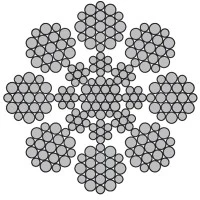
DIN 3055 is commonly associated with 6x7 steel wire rope. This construction has six outer strands, with seven wires in each strand.
Compared with constructions containing more, finer wires, a typical 6x7 rope has relatively large outer wires. This can provide good resistance to external abrasion, while the rope is generally less flexible than constructions such as 6x19.
Common considerations include:
Six strands with seven wires per strand.
Relatively large outer wires.
A comparatively stiff rope construction.
Potential use in guying, fencing, and other suitable general-purpose applications, depending on the complete specification.
The available core type, diameter, wire finish, tensile grade, and minimum breaking force must still be confirmed for the specific product.
DIN 3060: 6x19 Steel Wire Rope
DIN 3060 is commonly associated with 6x19 steel wire rope, featuring six strands with 19 wires per strand.
The greater number of wires generally allows a 6x19 construction to be more flexible than a comparable 6x7 rope. Its suitability for bending over sheaves or drums depends on the rope design, diameter, core, and equipment conditions.
Common considerations include:
Six strands with 19 wires per strand.
More, finer wires than a typical 6x7 construction.
Generally greater flexibility than 6x7.
Potential use in suitable general-purpose rigging and winch applications.
As with 6x7 rope, the construction designation alone does not establish the rope's load capacity or suitability for a specific lifting system.

2. DIN 3055 vs. DIN 3060: What Is the Difference?
The most visible difference is the number and arrangement of wires in each strand. This affects the rope's flexibility and its behavior under abrasion and bending.
| Comparison | DIN 3055 - 6x7 | DIN 3060 - 6x19 |
|---|---|---|
| Typical construction | 6 strands × 7 wires | 6 strands × 19 wires |
| Wire arrangement | Fewer, generally larger wires | More, generally finer wires |
| Flexibility | Generally lower | Generally higher |
| Outer-wire abrasion | Larger outer wires can be advantageous | Depends on wire arrangement and service conditions |
| Bending over sheaves | Must be checked for the equipment | May be preferable where greater flexibility is required |
| Selection priority | Consider where stiffness and external abrasion resistance matter | Consider where flexibility is important |
These are general construction-level comparisons, not guarantees for every rope. Actual performance depends on wire grade, core type, rope diameter, lubrication, lay, sheave diameter, load, and operating conditions.


3. How Do DIN, EN, and ISO Standards Relate to Each Other?
The terms DIN, EN, and ISO refer to different standards systems. They should not be treated as interchangeable labels.
DIN: German Standards
DIN designations are widely found in older technical documents, product catalogs, and established rope-trade terminology. Buyers may still encounter DIN 3055 and DIN 3060 when searching for 6x7 and 6x19 products.
EN: European Standards
EN standards are European standards. For stranded steel wire ropes intended for general lifting applications, EN 12385-4 is an important reference.
Product catalogs commonly list 6x7 rope as EN 12385-4 (DIN 3055) and 6x19 rope as EN 12385-4 (DIN 3060). These catalog descriptions help buyers recognize the traditional construction, but the full product specification and applicable standard edition should be verified.
ISO: International Standards
ISO standards provide internationally recognized technical requirements and terminology. However, the relevant ISO document depends on the rope's intended application and product type.
For example, ISO 2408:2017 covers requirements for manufacturing, testing, acceptance, packing, marking, and quality certificates for specified general-purpose steel wire ropes. Its scope excludes ropes for lifts (elevators), mining, aircraft control, aerial ropeways, and funiculars.
Therefore, ISO 2408 should not be presented as a direct standard equivalent for elevator wire rope. Elevator rope buyers must identify the applicable elevator-specific standards and the requirements of the equipment manufacturer.
4. Are DIN 3055 and DIN 3060 Directly Equivalent to ISO Standards?
Not necessarily.
A similar rope construction does not prove that two products comply with the same technical requirements. Standards may differ in scope, construction classifications, diameter ranges, tensile grades, minimum breaking force, test methods, tolerances, and documentation.
When comparing a DIN-designated rope with a product offered under an EN or ISO reference, check the following:
Rope construction: Confirm the number of strands, number and arrangement of wires, and whether the construction is conventional, Seale, Warrington, or another design.
Core type: Specify fiber core (FC), independent wire rope core (IWRC), or another required core.
Nominal diameter: Confirm the actual required diameter and applicable tolerances.
Tensile grade and minimum breaking force: Compare the values in the relevant technical documents rather than assuming they are identical.
Wire finish and lubrication: Check whether the rope is bright, galvanized, coated, or supplied with a specified lubricant.
Lay direction and lay type: Confirm the required rope lay and strand arrangement.
Testing and certification: Identify the applicable standard edition, inspection requirements, and documentation required for acceptance.
Application requirements: Confirm suitability for the actual equipment, load, bending conditions, and safety requirements.
For safety-critical applications, do not substitute a rope based on a DIN number or construction label alone. Ask the rope manufacturer or equipment designer to confirm technical suitability.
5. How to Choose the Right Steel Wire Rope
The right choice depends on the application rather than the standard name alone.
For Applications Prioritizing External Abrasion Resistance
A 6x7 construction may be worth considering where relatively large outer wires and a comparatively stiff rope are suitable for the service conditions. Verify the required core, diameter, load, and equipment compatibility.
For Applications Requiring Greater Flexibility
A 6x19 construction may be worth considering when the rope needs to bend around sheaves or drums. The permissible bending conditions and minimum sheave-to-rope diameter ratio should be checked against the manufacturer's specifications and equipment requirements.
For International Procurement
Provide the supplier with the required construction, diameter, core, tensile grade, minimum breaking force, wire finish, lay direction, intended application, and required standard. If you are replacing an existing rope, share its marking, certificate, technical drawing, or original specification whenever possible.
This information helps the supplier determine whether a proposed product is a suitable replacement rather than simply a similar-looking construction.
6. Steel Wire Rope Supply and Customization from Nantong Shenwei
Nantong Shenwei Steel Wire Rope Co., Ltd. supplies steel wire rope products for different industrial and commercial requirements, including galvanized and ungalvanized wire ropes, stainless steel wire ropes, elevator wire ropes, and coated wire ropes.
Product options and technical specifications vary by construction and application. Buyers can discuss diameter, core type, tensile grade, surface finish, rope length, lay direction, and packaging requirements with our team.
If you are sourcing DIN 3055-type 6x7 rope, DIN 3060-type 6x19 rope, or another steel wire rope construction, we recommend confirming the full specification before placing an order.
Conclusion
DIN 3055 and DIN 3060 are traditional steel wire rope designations commonly associated with 6x7 and 6x19 constructions. EN 12385-4 is an important reference for stranded ropes used in general lifting applications, while ISO requirements must be selected according to the product and its intended use.
The key to selecting an equivalent rope is to compare the complete technical specification-not just the standard number. Construction, core type, diameter, minimum breaking force, wire finish, testing requirements, and application conditions all matter.
Need help selecting a steel wire rope?
Contact Nantong Shenwei Steel Wire Rope Co., Ltd. to discuss your required construction, diameter, core type, finish, and application.
Website: https://www.shenwei-steelwirerope.com/
Email: nt@sw-steelwirerope.com
WhatsApp: +86 13708399562