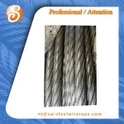
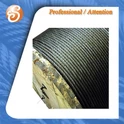
Galvanized steel wire is made of high-quality carbon structural steel such as 45#, 65#, 70#, and then galvanized (electrogalvanized or hot-dip galvanized).
Galvanized steel wire is a carbon steel wire that is galvanized on the surface by hot plating or electroplating. Its performance is the same as straightening and tempering steel wire. It can be used as unbonded prestressed tendon, but at least 200-300g zinc should be plated per square meter. Commonly used as parallel steel cable for cable-stayed bridges (in addition, flexible cable sleeves are used as outer protection)
Physical properties
The surface of the galvanized steel wire is smooth, smooth, without cracks, joints, burrs, scratches and rust. The galvanized layer is uniform, strong adhesion, durable corrosion resistance, excellent toughness and elasticity. The tensile strength should be between 900Mpa-2200Mpa (wire diameter Φ0.2mm-Φ4.4mm). The number of torsion (Φ0.5mm) is more than 20 times, and repeated bending should be more than 13 times.
The thickness of the hot-dip zinc layer is 250g/m. Greatly improve the corrosion resistance of steel wire.
Galvanized steel wire is mainly used for planting greenhouses, farms, cotton packing, spring and steel wire rope manufacturing. It is suitable for engineering structures with severe environmental conditions, such as steel cables and sewage tanks of cable-stayed bridges.
Zinc layer uniformity
The uniformity of the zinc layer affects the corrosion resistance and service life of the product, and should be included in the standard for testing and evaluation. The uniformity of the coating layer η or the average thickness H and the standard deviation S of the coating layer can be used to evaluate the uniformity of the coating layer. In the process of hot dip galvanizing, necessary measures should be taken to improve the uniformity of the galvanized layer [3].
The quality of the galvanized layer can be measured by the weight of the zinc plated on the substrate, the adhesion between the galvanized layer and the substrate, and the uniformity of the coating. The uniformity of the zinc layer is an important quality index of the galvanized layer. In general, corrosion always starts at the thinnest part of the zinc layer and spreads around, resulting in rust and wire breakage, which affects the service life. For the coating weight and bonding force, each standard has clear regulations, but the uniformity is different. In the 1970s, the ISO standard and the standards of various countries in the world generally required copper sulfate test to check. By the 1980s, except for Japan and the former Soviet Union, the ISO standard and the standards of countries around the world no longer adopted this method. Although some standards such as GB/T15393-94 "galvanized steel wire coating" in our country have retained this method in a way that "the agreement between the two parties can be carried out", most of them are no longer used. However, the old zinc layer uniformity detection method has been abandoned but no corresponding new method has been established. In addition, there is no uniform definition and requirement for uniformity, so that some producers do not monitor and detect the uniformity of the coating layer well. , Which has affected the further improvement of product quality [3].
For the galvanized steel wire, the uniformity of the coating is required to be uniform on the transverse (radial) cross-section, and second, the coating on each cross-section of the steel wire in the longitudinal (axial) is almost the same. Due to the jitter of the steel wire, the fluctuation of the zinc liquid level, and the surface scum in the plating pot, the local zinc layer accumulation on the steel wire surface (commonly known as zinc tumor) should be eliminated by correcting the tooling and standardizing the operation. Regardless of the random and random zinc layer accumulation, under the condition of determining tooling, stable process and the same operation specification, the zinc layer of each section of the total length of the steel wire will not have too much difference, so you can choose a vertical and The cross-section of the zinc-free layer is evaluated for the uniformity of the coating [3].
Measures to improve the uniformity of the steel wire galvanized layer: The reasons for the uneven coating of the steel wire hot-dip coating are:
(1) The wire drawing is not perpendicular to the zinc liquid surface, so that the plating solution brought out when the wire is drawn out cannot be uniformly down along the circumference of the wire under the force of gravity when it is not solidified, causing the coating to deviate from the geometric center of the wire after solidification;
(2) Wiping conditions (such as the charcoal particle size, the tightness of charcoal and steel wire contact, the flow and pressure of air wiping, etc.) in all directions of the wire circumference;
(3) Zinc liquid level fluctuation and steel wire jitter, zinc liquid surface scum on steel wire surface, etc.;
(4) The scraped zinc and zinc layer are deformed unevenly due to various reasons when the steel wire is plated and then drawn. In severe cases, even the local pure zinc layer is completely lost.
Measures to be taken: Improve the design and adjust the tooling to ensure that the steel wire positioned by the pressure roller and the wire roller of the lead-out frame is perpendicular to the zinc liquid surface. When the pressure shaft is worn, the position of the wire roller must be adjusted in time or the pressure shaft must be rotated to ensure that the wire is perpendicular to the liquid surface. The charcoal particles to be wiped should be even and firm. Add zinc far away from the lead-out and push it in slowly. The position of the pressing shaft to the operation surface of the zinc pot should not be too close. It is better to have a tension control device on the production line to prevent the zinc liquid level from fluctuating.