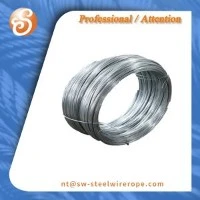
If you’ve ever walked past a chain-link fence, a outdoor wire clothesline, or a garden trellis that’s still holding up after years in rain and snow, you’ve probably used galvanized steel wire without even realizing it. But if you’re in the market for this stuff (or just curious why it doesn’t rust like plain steel), you’ve likely asked a question we get at our warehouse every week: What’s the real corrosion resistance of galvanized steel wire?
Look, I won’t bore you with a bunch of textbook jargon right off the bat. Let’s start with the basics: Galvanizing is just a process where we coat steel wire with a layer of zinc to keep rust from forming. Rust happens when iron in steel reacts with oxygen and water to make iron oxide—ugly, weak, and basically the worst thing for metal that’s supposed to last outdoors. Zinc acts like a two-layered defense here, and that’s where its corrosion resistance comes from.
First, there’s the “barrier layer” part. That zinc coating physically covers every inch of the steel wire, sealing it off from moisture and oxygen that would otherwise hit the iron directly. But here’s the kicker: zinc is actually more reactive than iron. So if the coating gets scratched, chipped, or worn down (say, from rubbing against a fence post or pulling tight on a clothesline), the zinc acts like a sacrificial anode. It corrodes first, leaving the steel underneath untouched for way longer than if the zinc wasn’t there at all. This is called cathodic protection, and it’s a game-changer for stuff that’s going to be exposed to the elements.
Not all galvanized wire is the same, though. That’s a big mistake a lot of buyers make—they see “galvanized” on a product spec and assume it’s all equal. We stock a few different types, each with their own corrosion resistance depending on how the zinc is applied, how thick the coating is, and what the wire’s end use will be. Let’s break down the most common ones because that’s where the confusion lives.
Hot-dip galvanizing is the workhorse of outdoor applications, and it’s what most people think of when they say galvanized wire. The process here is super simple (in theory): you run pre-cleaned steel wire through a bath of molten zinc, let it coat evenly, and pull it out to cool. The result is a thick, rugged zinc layer that’s way more durable than other types. For example, our High-Tensile Hot-Dip Galvanized Steel Wire (1.0mm - 4.5mm) with Heavy Zinc Coating is made specifically for situations where the wire will be exposed to harsh, wet environments—think agricultural fencing, marine docks, or highway guardrails. The heavy zinc coating on that stuff is usually 85 microns or more (that’s way thicker than the thin layer you get from other methods), and in mild climates like the Pacific Northwest or the upper Midwest, that coating can last 20 to 50 years with minimal maintenance. In harsher areas near the ocean, where salt air speeds up corrosion, you’ll still get 10 to 15 years out of it, which is way longer than plain steel would ever last.
Then there’s electro-galvanized wire, which is a totally different beast. Instead of dipping the wire in molten zinc, you run it through a solution and apply an electric current to deposit a thinner layer of zinc onto the steel. The coating here is usually only 5 to 25 microns thick—way less than hot-dip. That makes it cheaper, but its corrosion resistance is nowhere near as good. It’s great for indoor uses, like tying cables together or making small craft wire, but if you hang it outside, it might start showing rust in 2 to 5 years. Our 2.5mm Electric Galvanized Steel Wire is perfect for those indoor jobs where you don’t need heavy-duty protection, and it’s a go-to for customers building DIY projects inside or using it for temporary applications.
Wait, but what about specific use cases? Because corrosion resistance isn’t one-size-fits-all. Let’s say you’re making a spring for a outdoor swing set—you need wire that can flex without the zinc coating cracking, right? Plain hot-dip wire can be too brittle for bending, so our Galvanized Spring Steel Wire is made with a special process that keeps the zinc layer flexible while still being thick enough to resist rust. We’ve had customers use this for swing sets, trampolines, and even agricultural equipment like gate hinges, and it holds up way better than regular galvanized spring wire because the coating doesn’t chip when the spring gets stretched or compressed thousands of times.
Another common question: what about wire used for fiber optic cables? That’s a niche but important application, right? The strength members inside those cables need to be super strong, light, and resistant to corrosion because they’re buried underground or strung above ground for decades. Our High Tensile Steel Wire for Optical Fiber Cable Strength Member is hot-dip galvanized with a uniform zinc coating that’s designed to resist corrosion from soil chemicals, moisture, and even occasional exposure to road salt. We tested a batch of this wire last year in a soil simulant that had high levels of acidity, and after 500 hours (that’s equivalent to years of real-world exposure), the zinc coating was still intact—no rust, no weakening of the steel core. That’s exactly what telecom companies need when they’re laying cables that have to last 25 years or more.


Even within hot-dip, there are differences that affect corrosion resistance. The thickness of the zinc layer is the big one—thicker coating = longer life, plain and simple. We always specify zinc coating weight in our product descriptions, not just “galvanized.” For example, our heavy hot-dip wire has a zinc coating weight of at least 600 grams per square meter, while standard hot-dip is around 350 grams per square meter. That extra zinc adds a lot of protection—tests show that each 100 grams per square meter of zinc adds about 3 to 5 years of life in outdoor environments.
What about other factors that affect corrosion, even with galvanized wire? Stuff like humidity, salt, chemicals, and temperature. If you’re in a place with high humidity (like Florida or the Gulf Coast), corrosion speeds up because the air has more moisture. Salt near the ocean or on winter roads is even worse—it’s like a rust accelerator because salt ions break down the zinc barrier faster. In those cases, we always recommend our heavy hot-dip wire over standard or electro-galvanized, because the thicker zinc can handle that extra abuse. We also have a 0.37mm High Carbon Steel Wire that’s used for things like fishing lines, piano wires, and small industrial fasteners—its corrosion resistance is good for its thin gauge because the high carbon steel is paired with a uniform hot-dip coating, so even though it’s only 0.37mm thick, it won’t rust as fast as other thin wires.
I know a lot of customers have run into bad galvanized wire before—stuff that starts rusting after a year, that’s actually just plain steel with a super thin zinc coat that barely covers it. That’s why we’re so transparent about our processes here at our company. We don’t cut corners on zinc thickness, and all our galvanized wire goes through salt spray testing before it leaves our warehouse. Salt spray testing is basically a way to simulate years of exposure to salt air in a matter of days—if our wire passes 1000 hours of salt spray without rust, that means it’s good for at least 10 years in a coastal environment. If it passes 2000 hours, that’s good for 20 years or more.
Let’s do a quick real-world example to make this concrete. Last year, a customer from Seattle (which is super rainy and near the ocean) bought 5000 meters of our heavy hot-dip wire to build a perimeter fence for their farm. They told us they used cheap galvanized wire from a big box store a few years back, and that wire had rusted through in 3 years. Our wire went up in spring 2022, and as of 2024, they said there’s zero visible rust on any of it, even the parts that are exposed to salt spray from the Puget Sound. That’s the difference between quality galvanized wire and the cheap stuff—its corrosion resistance isn’t just a number on a spec sheet, it’s something you can actually see and use every day.
Now, a few myths I hear all the time that I want to clear up. First myth: Galvanized wire never rusts. Nope, that’s not true. It will rust eventually, just way slower than plain steel. If you scratch the coating deep enough to expose the steel, that spot will start to rust, but the surrounding zinc will protect it for a long time. Second myth: Electro-galvanized is just as good as hot-dip for outdoor use. No way—electro-galvanized’s thin coating will corrode through in a few years, especially in wet or salty conditions. Third myth: Thinner wire has worse corrosion resistance. Not necessarily—if the coating is uniform, even thin wire can hold up well. Our 0.37mm high carbon wire is thin, but its uniform hot-dip coating means it resists corrosion way better than a thicker electro-galvanized wire with a thin, patchy coat.
So, putting it all together: The corrosion resistance of galvanized steel wire depends on three main things: how the zinc is applied (hot-dip vs electro), how thick the zinc coating is, and what environment it’s going to be used in. For most outdoor, heavy-duty uses (fencing, dock parts, cable strength members), our high-tensile hot-dip wire with a heavy zinc coating is the best bet—it can last decades in mild climates, and even 10+ years in harsh coastal or salty areas. For indoor or temporary uses, our electro-galvanized wire works fine, but don’t expect it to hold up outside.
At the end of the day, choosing the right galvanized wire is all about matching the product to your needs. If you’re not sure which type is best for your project, just reach out. We’re here to help—we don’t just sell wire, we’ve spent years testing what works and what doesn’t in real-world conditions. Whether you need wire for a farm fence, a fiber optic cable strength member, a spring, or a small craft project, we’ve got you covered. No pressure, no hard sells—just honest advice about what will hold up and what won’t.
References
- American Galvanizers Association. (2023). Galvanized Steel: Corrosion Resistance and Design Life. Retrieved from againfo.org
- International Organization for Standardization. (2019). ISO 1461: Hot-Dip Galvanized Coatings on Fabricated Steel Articles – Specifications and Test Methods.
- Steel Wire Industry Association. (2022). Corrosion Performance of Galvanized Steel Wires for Outdoor Applications.
- National Association of Corrosion Engineers. (2021). Effects of Environmental Factors on Zinc Coating Degradation.