Introduction
Choosing the right steel wire rope is essential for safety, durability, and cost-effective performance. Among the most widely used options, stainless steel wire rope and galvanized steel wire rope are both designed to provide corrosion resistance, but they are suitable for different working environments.
Stainless steel wire rope offers excellent corrosion resistance, clean appearance, and long-term performance in highly corrosive environments. Galvanized steel wire rope provides a strong balance between corrosion protection, mechanical strength, and cost.
So, which one should you choose?
This guide compares stainless steel and galvanized steel wire rope in terms of corrosion resistance, strength, appearance, applications, service life, and cost.

1. Stainless Steel Wire Rope
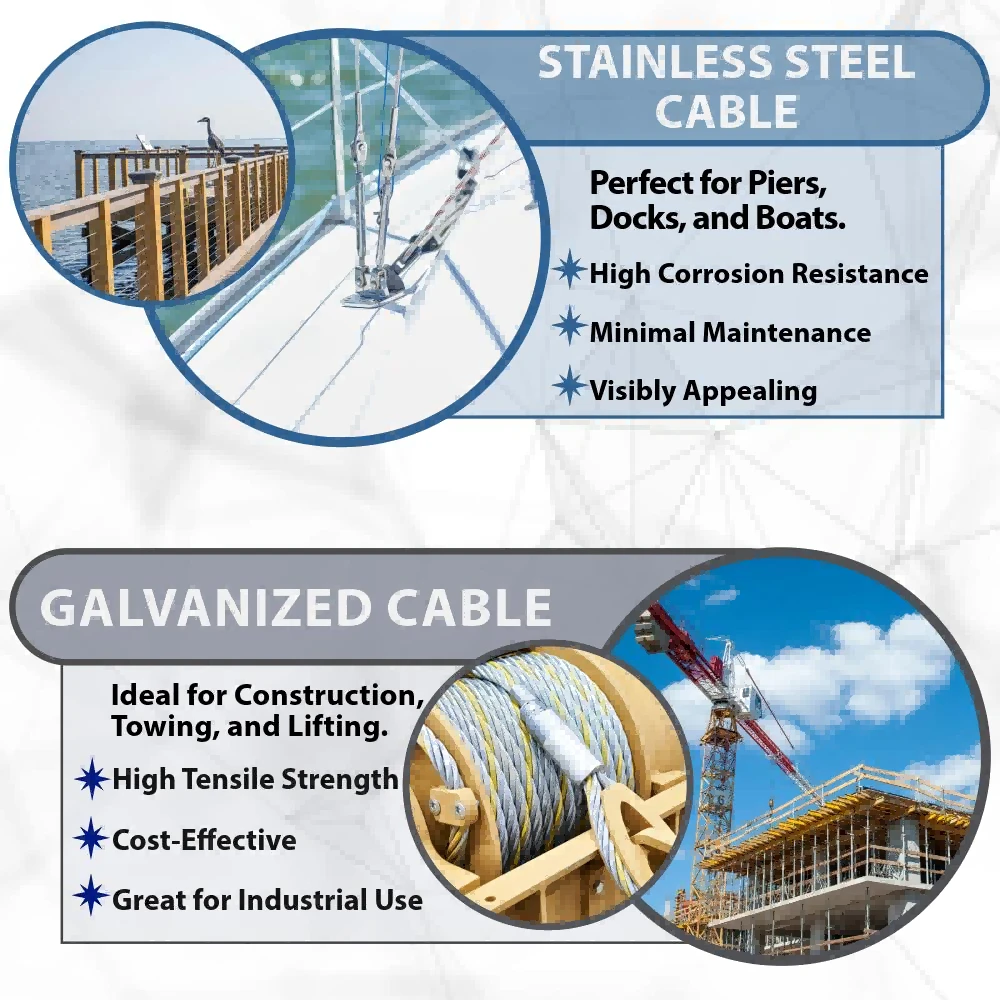
Stainless steel wire rope is manufactured from stainless steel grades such as 304 and 316. Its chromium content forms a passive oxide layer on the surface, providing excellent resistance to corrosion and oxidation.
316 stainless steel generally offers better resistance to chlorides and saltwater than 304 stainless steel, making it a preferred option for marine and highly corrosive environments.
Key Advantages
Excellent corrosion resistance
Strong resistance to moisture and salt spray
Clean and attractive appearance
Low maintenance requirements
Suitable for long-term outdoor applications
Typical Applications
Marine and offshore equipment
Cable railing systems
Architectural structures
Food processing equipment
Chemical and industrial environments
Outdoor decorative application


2. Galvanized Steel Wire Rope
Galvanized steel wire rope is manufactured from carbon steel wire with a protective zinc coating. The zinc layer acts as a barrier against moisture and corrosion while providing sacrificial protection to the underlying steel.
Depending on the manufacturing process and coating requirements, galvanized wire rope can offer different levels of corrosion resistance.
Key Advantages
Good corrosion resistance
High mechanical strength
Cost-effective
Suitable for outdoor environments
Available in a wide range of constructions and sizes
Typical Applications
Cranes and lifting equipment
Construction machinery
Mining equipment
Agriculture
General industrial equipment
Marine and outdoor applications


3. Stainless Steel vs. Galvanized Steel Wire Rope
| Feature | Stainless Steel Wire Rope | Galvanized Steel Wire Rope |
|---|---|---|
| Corrosion Resistance | Excellent | Good to Excellent |
| Saltwater Resistance | Excellent, especially 316 | Good |
| Strength | High | High |
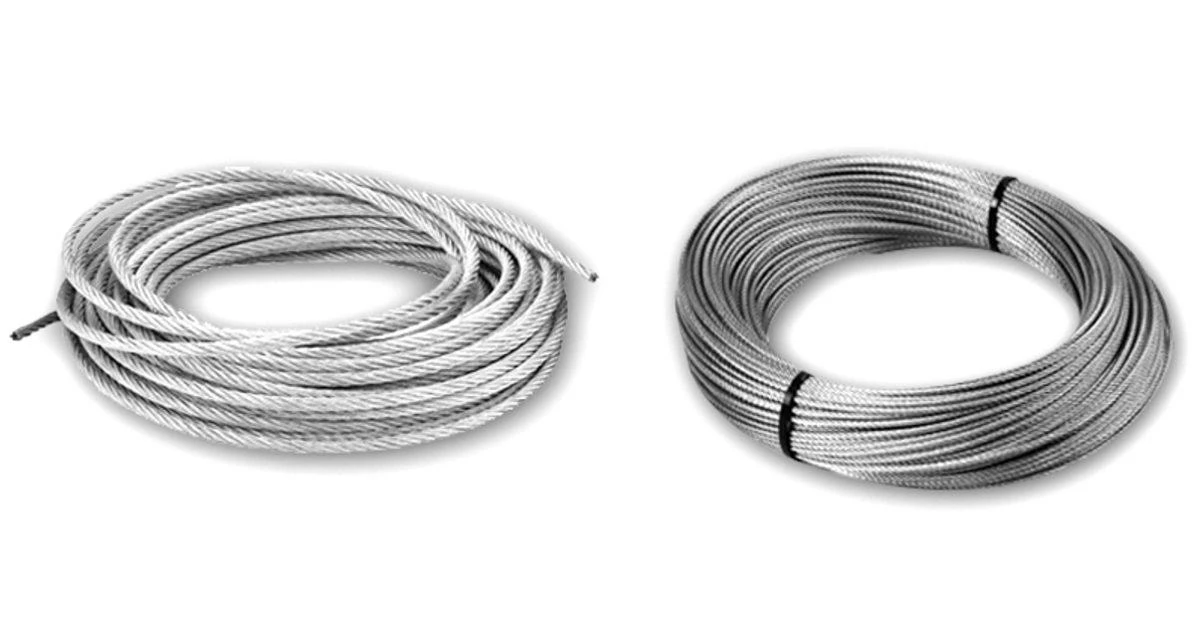
| Appearance | Bright & clean | Metallic gray |
| Maintenance | Low | Moderate |
| Outdoor Use | Excellent | Excellent |
| Cost | Higher | More economical |
| Best For | Highly corrosive environments | General outdoor & industrial use |
4. Corrosion Resistance
Corrosion resistance is one of the biggest differences between these two wire ropes.
Stainless steel wire rope is naturally corrosion resistant because of the chromium content in the steel. 316 stainless steel is particularly suitable for environments exposed to seawater, salt spray, and chemicals.
Galvanized steel wire rope relies on its zinc coating for corrosion protection. Once the zinc coating is damaged or consumed over time, the underlying steel becomes more vulnerable to corrosion.
Which Is Better?
For highly corrosive environments:
316 Stainless Steel > 304 Stainless Steel > Galvanized Steel
However, the actual performance depends on the environment, coating thickness, rope construction, maintenance, and operating conditions.


5. Strength and Mechanical Performance
Both stainless steel and galvanized steel wire ropes can provide excellent mechanical performance.
Galvanized steel wire rope is widely used for heavy-duty lifting because of its combination of tensile strength, durability, and cost efficiency.
Stainless steel wire rope provides good strength while offering superior corrosion resistance. However, the exact breaking load depends on the steel grade, wire rope construction, diameter, and tensile strength.
For heavy lifting applications, buyers should always select wire rope according to the required minimum breaking force and working load, rather than choosing based only on material.
6. Appearance and Maintenance
Stainless steel wire rope has a smooth, bright, and clean appearance, making it popular for architectural and decorative applications.
It is commonly used in:
Glass railing
Stair railings
Cable railing
Exhibition structures
Architectural designs
Galvanized wire rope has a typical silver-gray metallic appearance. It is generally selected when functional performance and cost are more important than appearance.
7. Which One Should You Choose?
Choose Stainless Steel Wire Rope When:
✔ The application is exposed to seawater or salt spray
✔ Corrosion resistance is a top priority
✔ A clean and attractive appearance is required
✔ Long-term outdoor exposure is expected
✔ Low maintenance is preferred
Choose Galvanized Steel Wire Rope When:
✔ Cost efficiency is important
✔ The application requires high mechanical strength
✔ The environment is outdoor but not extremely corrosive
✔ The rope is used for cranes or lifting equipment
✔ A wide range of sizes and constructions is required
8. Common Applications
| Application | Recommended Wire Rope |
|---|---|
| Marine & Offshore | Stainless Steel / Galvanized |
| Cable Railing | Stainless Steel |
| Construction Cranes | Galvanized |
| Mining | Galvanized |
| Architectural Projects | Stainless Steel |
| Agriculture | Galvanized |
| Chemical Environment | Stainless Steel |
| General Industrial Use | Galvanized |
The final selection should always be based on the actual working environment, load requirements, equipment design, and applicable standards.


Conclusion
There is no single wire rope that is best for every application.
Stainless steel wire rope is an excellent choice when corrosion resistance, appearance, and long-term performance are the highest priorities, particularly in marine, architectural, and highly corrosive environments.
Galvanized steel wire rope provides an excellent balance of strength, corrosion protection, versatility, and cost, making it a popular choice for construction, lifting, mining, agriculture, and general industrial applications.
By evaluating the working environment, load requirements, corrosion conditions, and budget, buyers can select the right wire rope for their specific project.